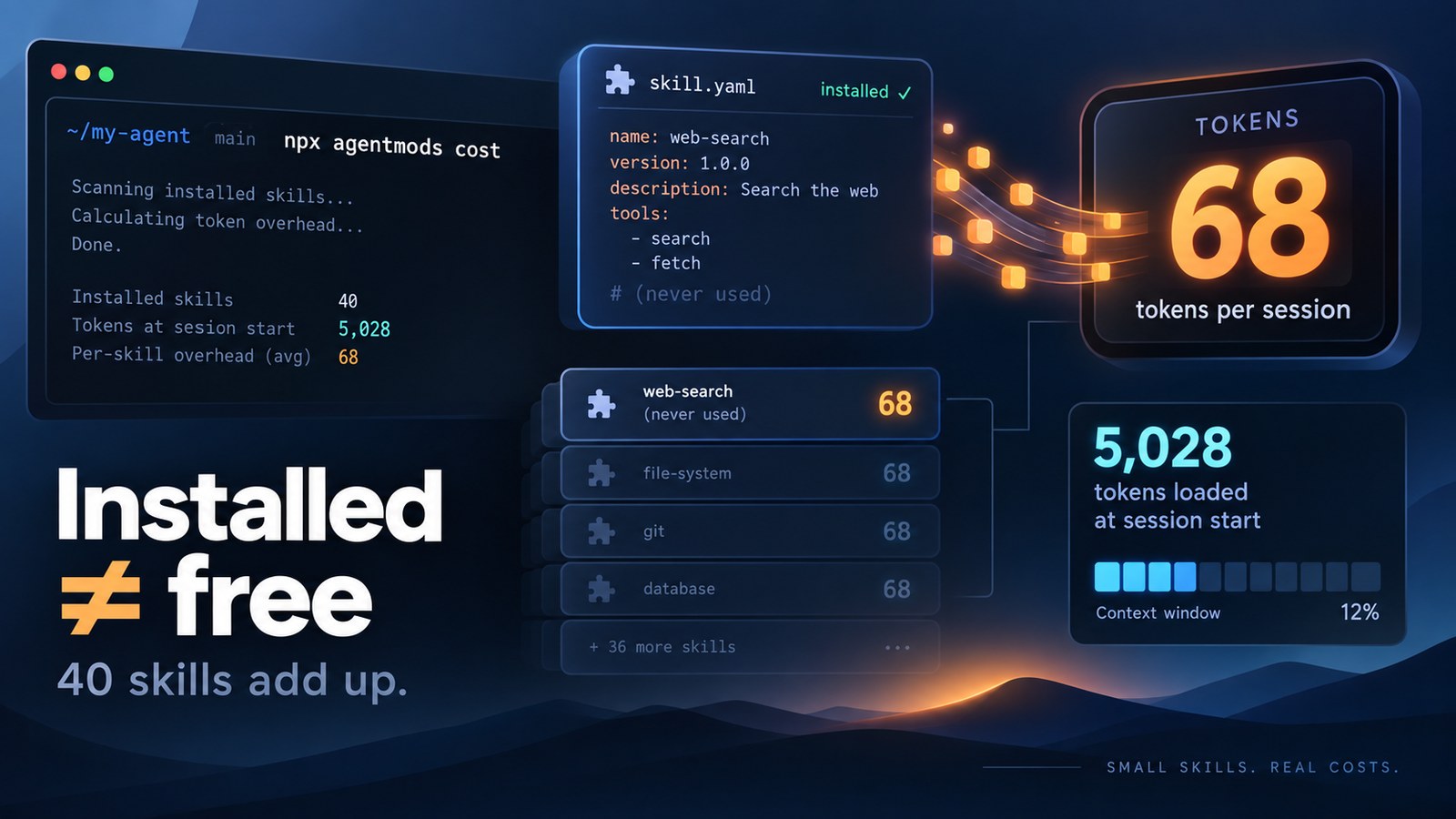
A skill you have installed but never invoke still costs you something on every
session. For the Cloudflare skill in anomalyco/opencode, that something is 68
tokens. I want to explain where that number comes from, because almost nobody
who installs a skill has been shown it.
Two numbers, not one
A Claude Code skill is one file with two parts. There is a YAML header with the skill’s name and a description of what it does, and there is the body: the actual instructions.
Only the header is loaded when your session starts. The agent has to know the skill exists in order to reach for it later, so it reads the name and the description of everything you have installed, every time. The body stays on disk until something invokes it.
That is why the Cloudflare skill has two figures against it. Sixty-eight tokens is what it costs to have it installed. One thousand seven hundred and forty-seven is what it costs when you actually use it.
Those 68 tokens are not an abstraction. They are the skill’s name and its description, and nothing else:
name: cloudflare
description: Comprehensive Cloudflare platform skill covering Workers, Pages,
  storage (KV, D1, R2), AI (Workers AI, Vectorize, Agents SDK), networking
  (Tunnel, Spectrum), security (WAF, DDoS), and infrastructure-as-code
  (Terraform, Pulumi). Use for any Cloudflare development task.
The header holds other fields too, and the loading rule does not count them. The file itself is 212 lines and 7,799 bytes. You pay for those two fields on every session, and for the rest only when the agent decides Cloudflare is what you are working on.
One skill is free
At Claude Opus 5 prices, which are five dollars per million input tokens, 68 tokens costs $0.00034. A thousand sessions with that skill installed comes to thirty-four cents. Sonnet 5 is two dollars per million and Haiku 4.5 is one, so the number gets smaller from there.
I am not going to pretend that matters. One skill is free in any sense that affects your invoice.
Forty skills are not
The number that matters is the sum, and the sum is invisible. Nothing in your agent prints it.
I ran the measurement against a working developer machine, mine, and found 5,028 tokens loading on every session before a single word was typed. That is two and a half cents a session on Opus. Twenty sessions a day for a month is about fifteen dollars, which is still not a catastrophe, but it is fifteen dollars for a thing nobody chose.
You can check your own in about ten seconds:
npx agentmods costIt reads your actual configuration, including the skills installed globally in
~/.claude, and prints the total with a price against each model. The output
is local to your machine and nothing is sent anywhere.
Instructions files are a different problem
Skills are polite. They announce themselves in a sentence and stay quiet.
Instructions files are not polite: CLAUDE.md, AGENTS.md, whatever your
agent reads to learn how your project works. They have no header-and-body
split. They load whole, at the start of every session, whether the session
touches the thing they describe or not.
Across the catalogue, the median instructions file costs 957 tokens per session. The median skill costs 53. At the 90th percentile the gap widens: 4,255 tokens against 133.
The largest instructions file I have measured costs 55,112 tokens on every session. That is roughly a quarter of a two-hundred-thousand-token context window, spent before the first question, on one file. At Opus prices it is twenty-eight cents a session. Somebody installed it, and I would guess nobody told them.
Cursor rules sit between the two: a median of 46 tokens, but a 90th percentile of 1,247 and a maximum of 41,079. The median is misleading there in a way it is not for skills.
The costs that are not money
Two more things get spent, and neither shows up on a bill.
The first is context. Everything loaded at session start occupies the window for the whole session. Five thousand tokens out of two hundred thousand is two and a half per cent, which is survivable. Fifty-five thousand is not survivable in the same sense. It is a quarter of the room your actual work needs.
The second is attention. The agent reads every installed skill’s description in order to choose between them. Five descriptions are easy to tell apart. Eighty descriptions, many of them written to sound broadly applicable, are not. The cost of a crowded skill directory is not only the tokens; it is that the agent picks worse. I cannot measure that one, so I am not going to put a number on it, but it is the reason I would not install everything I could.
How the numbers were produced
Every figure here comes from a catalogue of 780,043 mods across 146,630 GitHub repositories, measured on 5 September 2026.
The tokens are counted with a real tokenizer against each agent’s documented loading rules, not estimated by dividing characters by four. That distinction is the whole point: a skill and an instructions file of identical length cost wildly different amounts per session, and only the loading rule tells you which. Where a rule is ambiguous, and some agents document their behaviour better than others, the catalogue records which rule it applied, so you can disagree with it.
The prices are Anthropic’s published input prices for Claude Opus 5, Sonnet 5 and Haiku 4.5. Output tokens are not counted here at all; this is the cost of your setup existing, not the cost of using it.
The catalogue re-crawls itself nightly, so these figures have already moved a little by the time you read them. The per-mod pages carry the current number, and each one says how it was measured.
What I would do with this
Nothing, mostly. Most mods are cheap and thinking about them is a waste of a morning.
The number earns its keep in one case: when it is unexpectedly large. A skill that costs 2,606 tokens to announce itself is doing something wrong. An instructions file at 55,112 is not a configuration choice, it is an accident. Those exist, they are installed in real projects, and until somebody counted them the same way twice there was no way to find out.
Run npx agentmods cost once. If the total surprises you, the surprise is the
useful part.