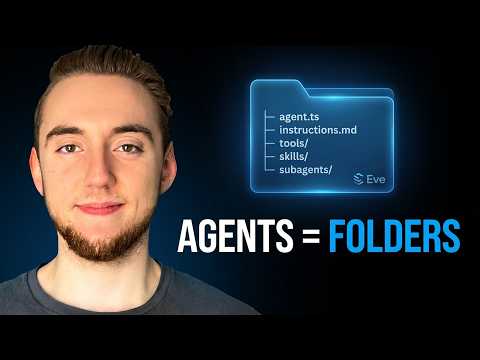
eve is a filesystem-first framework for building durable AI agents, with agent instructions, tools, and configuration kept in ordinary project files. It is for developers creating agents that can be inspected, extended, and operated through a conventional codebase. The catalogue add-ons support working with eve agents and their workflows.
Getting it into your agent
One page per mod, every tool's command on it. A separate URL per tool would split the same page into five that compete with each other.
npx skills add vercel/eve --skill evegit clone --depth 1 https://github.com/vercel/eveWrote this? Show the measurements
A badge with what this costs and how it scanned, read live from this page, so it follows the numbers instead of freezing them. Markdown for a README, HTML for a documentation site or a project page.

[](https://agentmods.dev/skills/vercel/eve/eve)<a href="https://agentmods.dev/skills/vercel/eve/eve"><img src="https://agentmods.dev/badge/skills/vercel/eve/eve/github.svg" alt="Measured on agentmods" height="20"></a>Or the 80×15 button, for a site that already has a row of RSS and ATOM ones. Only the verdict fits; the numbers stay here.

<a href="https://agentmods.dev/skills/vercel/eve/eve"><img src="https://agentmods.dev/badge/skills/vercel/eve/eve.svg" alt="Reviewed on agentmods" width="80" height="20"></a>- Socket pass
- Snyk pass
- NVIDIA SkillSpector warn
SkillSpector: 1 finding, up to medium
These are SkillSpector’s own severities. On a checked sample its high-severity flags on skills were ~96% false positives — a documented command, a public API, a “never do X” rule — so we show them as a caution to read, not a verdict. Why →
- medium MCP Rug Pull · line 27 npx commands without a version suffix (e.g. @1.0.0) create a rug-pull risk if the upstream server is compromised and publishes a malicious update.Fix: Pin the version: npx @scope/[email protected]
What it costs to keep this loaded
Counted locally with the o200k_base tokenizer, which is exact for GPT models; Claude uses its own tokenizer and its counts differ. Treat this as one consistent yardstick across the catalogue rather than a bill. Prices are per million input tokens.
| Model | Per session | Once invoked |
|---|---|---|
| Fable 5.1 | $0.00047 | $0.00231 |
| Opus 5.5 | $0.00019 | $0.00092 |
| Sonnet 5.5 | $0.00009 | $0.00046 |
| Haiku 4.5 | $0.00005 | $0.00023 |
Grade A, and why
eve scanned grade A with 0 findings against 26 rules in 11 categories — prompt injection, anti-refusal, data exfiltration, privilege escalation, supply chain, agent snooping, system-prompt leakage, SSRF and excessive agency — measured 1mo ago.
A static scan of the body, not an audit. Every finding is printed with the line that produced it so you can judge whether it matters here. A mod is markdown that instructs an agent; that is exactly why what it instructs is worth reading.
Nothing flagged
None of the 26 patterns this scan looks for appear in this file: no shell pipes, no recursive deletes, no credential paths, no hidden text, no instruction-override or anti-refusal phrasing, no agent-config snooping. That is not a guarantee, it is the absence of the things that are checkable.
This is a copy
89% identical to eve — 2 lines differ, which has more behind it and is treated as the original. This page carries a canonical link to it rather than competing with it.
What it actually says
eve
eve is a filesystem-first framework for durable backend AI agents. An agent is a directory on disk — instructions, skills, tools, connections, channels, subagents, and schedules are all files — and eve compiles and runs it.
Source of truth
The complete documentation ships inside the eve package. Do not rely on this
skill for guidance — always read the bundled docs, which match the installed
version exactly:
node_modules/eve/docs/
Start with node_modules/eve/docs/README.md. It contains the full
index and recommended reading order. Before writing any eve code, read the
relevant guide there first.
If eve is not installed yet, install it (npm install eve) or scaffold a new
agent with npx eve init <agent-name>, then read the bundled docs.
What this file has done since we first saw it
Hashed on every crawl. A supply-chain change to an agent config is a question of when, not whether, so the history is kept rather than the latest state alone.
- 1mo ago First seen · 28 lines · 47 tokens per session scan A 35a7c82f96e2
eve is a skill published in the GitHub repository vercel/eve (5,617 stars, last pushed today), licensed Apache-2.0. It adds 47 tokens to every session and 231 once invoked, about $0.0002 per session on Opus 5.5. A static security scan graded it A with 0 findings. It is 89% identical to eve, differing in 2 lines, and is treated as a copy.
Other skills, from other repositories
analyzing-experiment-query-performance
Pull and interpret production experiment query-performance data from the staff-only /api/debugchqueries endpoints backing the /experiments/staff scene: slowest experiment queries, precompute read/build health, and preaggregation cache footprint. Covers prod-US and prod-EU via a queryperformance:read personal API key…
frontmcp-guides
Tutorials, end-to-end walkthroughs, and complete reference projects for FrontMCP. Use when you want a getting-started guide, a full worked example, or to learn best practices by following a step-by-step build rather than a single API reference. Includes a beginner weather-API server (tool plus static resource, Zod…
incident-response-skill
A skill that uses object-style tool references with purpose descriptions and required flags, plus strict validation.
parameterized-skill
A skill with customizable parameters, usage examples for AI guidance, and controlled visibility.
triaging-warehouse-sync-tickets
Debug a customer's data warehouse source, schema, or table from a support ticket, using PostHog's own production data. Use when a ticket says a warehouse table is stale, empty, stuck, duplicated, missing rows, or failing to sync, and you need the real state of the sync rather than the customer's description. The…
maf-fan-out-validator
Validates fan-out / fan-in workflow topology — detects the silent fan-in starvation pattern (handlers returning void / non-generic Task that produce no downstream message). Canonical rules + procedure for what the compiler cannot catch and the build cannot surface.